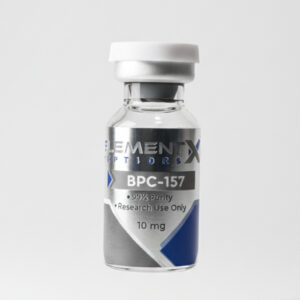
BPC-157 (Gastric Pentadecapeptide)
BPC-157 is a synthetic pentadecapeptide widely used in advanced laboratory research focused on tissue biology and cellular signalling. Originally identified as a fragment derived from studies of human gastric juice, BPC-157 is characterised by its stable 15-amino-acid sequence and well-defined physicochemical properties, making it a valuable tool for in-vitro experimental models.
This research-grade peptide enables controlled investigation of cell migration, angiogenesis-related signalling, survival pathways, and extracellular tissue responses under non-clinical laboratory conditions.
⚠️ Important Notice
All products are produced exclusively for controlled laboratory research and development applications.
Not for human or animal consumption.
🔬 Suitable R&D Applications
🧪 Cell Signalling & Tissue Biology
• Investigation of peptide-mediated intracellular signalling
• Studies of cell migration, adhesion, and survival pathways
• Evaluation of angiogenesis-associated mechanisms in vitro
⚗️ Peptide Stability & Physicochemical Profiling
• Thermal and pH stability assessments
• Structural integrity and degradation profiling
• Shelf-life evaluation for peptide formulations
🧩 Formulation & Compatibility Studies
• Interaction with excipients and carrier matrices
• Compatibility testing for research-grade formulations
• Support for peptide delivery system development
🔒 Enzymatic & Proteolytic Resistance
• Assessment of susceptibility to enzymatic degradation
• Comparative studies of peptide durability and stability
📦 Encapsulation & Delivery Research
• Liposomes, microspheres, and polymer-based carriers
• Controlled-release and peptide protection models
📄 Product Information
Product name: BPC-157
Synonyms: Body Protective Compound-157; Bepecin; PL-14736
Amino-acid sequence: Gly-Glu-Pro-Pro-Pro-Gly-Lys-Pro-Ala-Asp-Asp-Ala-Gly-Leu-Val
Molecular formula (free base, reference): C₆₂H₉₈N₁₆O₂₂
Molecular weight (free base, reference): ~1,419.5 g/mol
CAS (reference): 137525-51-0
Form: Lyophilised powder
Appearance: White to off-white solid