GHK-Cu (Copper Tripeptide) – Research Grade Peptide Complex
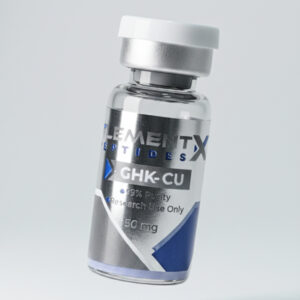
GHK-Cu (Copper Tripeptide) is a copper(II) complex of the naturally occurring tripeptide Gly–His–Lys (GHK), widely used in controlled in-vitro laboratory studies to investigate extracellular matrix (ECM) signalling, collagen synthesis pathways, and cell-surface interactions under non-clinical research conditions.
Through its ability to modulate copper-dependent biochemical interactions, GHK-Cu serves as a valuable research tool for studying cellular communication, tissue modelling, and molecular mechanisms involved in structural integrity and regeneration at the extracellular level.
Product Information
-
Product name: GHK-Cu (Copper tripeptide)
-
Synonyms: Copper peptide; Cu-GHK; Tripeptide-1 copper; Prezatide copper
-
Peptide component (GHK) sequence: Gly–His–Lys
-
Complex formula (reference): C₁₄H₂₄CuN₆O₄
-
Approx. molecular weight (complex, reference): ~401–404 g/mol
(varies by counter-ion and hydration state)
-
CAS (commonly reported):
-
49557-75-7 (complex)
-
89030-95-5 (TFA salt)
-
Form: Lyophilised powder
-
Appearance: Blue to blue-green solid
-
Note: Identity and exact properties may vary depending on salt form, counter-ion, and hydration
⚠️ Important Notice
All products are produced exclusively for controlled laboratory research and development applications.
Not for human or animal use.
🔬 Suitable R&D Applications
🧪 Extracellular Matrix Signalling Studies
⚗️ Collagen Pathway Research
🧩 Cell-Surface Interaction Analysis
🔒 Peptide–Metal Complex Stability Testing
📦 Formulation & Compatibility Research
🧬 Cell-Based & Molecular Assays